Red Oak price per board foot
Plan on about $4.10 a board foot for 4/4 stock at U.S. retail (our 2026-08 estimate — your yard gets the final word). A typical board, 6″ wide and 8′ long, will run you around $16.40.
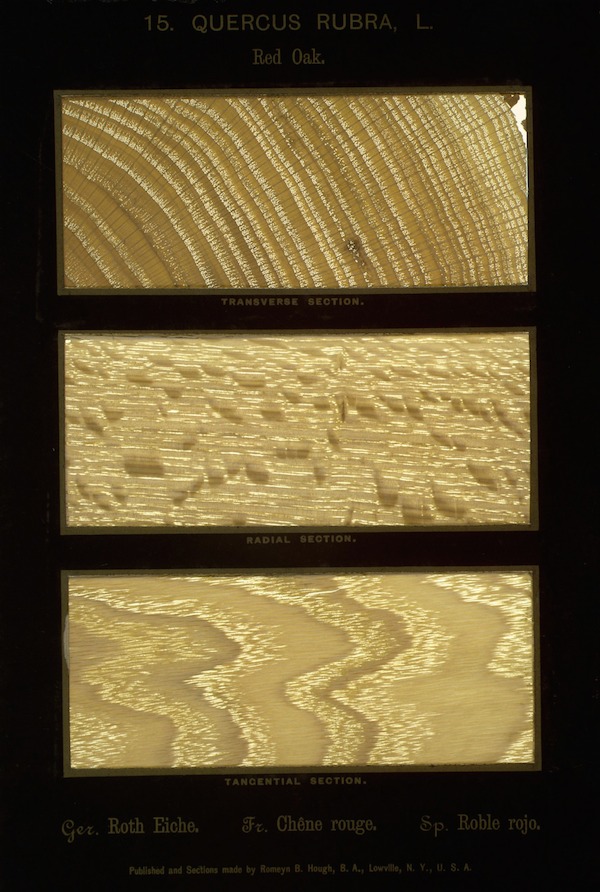
Look around any American kitchen renovated between 1975 and 1995 and you're probably looking at red oak under amber varnish — the 'golden oak' era put this wood in more homes than any hardwood in history. Cut a short piece, dip one end in water, and blow through the other like a straw: bubbles. The pores run open end to end, which is also the whole reason red oak can't hold a barrel of whiskey and doesn't belong outdoors.
Widely available and predictable to machine. Open pores drink finish; not for outdoor use. The default American cabinet wood for decades.
Red Oak at a glance
| Price per board foot | $4.10 (2026-08) |
| Weight, dry | 44 lb/ft³ · 3.7 lb per BF |
| Janka hardness | 1,220 lbf |
| Shrinkage, green → oven-dry | 8.6% tangential · 4.0% radial |
| Cost of 10 BF | $41.00 |
| Cost of 25 BF | $102.50 |
What common thicknesses cost
Same 6″ × 8′ board, priced by rough thickness (thicker stock often carries a small premium on top of this — figured on volume alone):
| Thickness | Board feet | Cost | Weight |
|---|---|---|---|
| 4/4 | 4.0 | $16.40 | 15 lb |
| 6/4 | 6.0 | $24.60 | 22 lb |
| 8/4 | 8.0 | $32.80 | 29 lb |
| 12/4 | 12.0 | $49.20 | 44 lb |
Will it stay flat?
Middle of the pack, honestly — livelier than cherry or walnut, calmer than beech or hickory. If a wide red oak panel is in your plans, quartersawn stock takes most of the drama out of it.
The measured numbers: drying from green, red oak shrinks about 8.6% across a flatsawn board's width (tangential) and 4.0% across quartersawn (radial) — that ratio is why the two cuts behave so differently in your house.
Buying red oak without regrets
This is usually the cheapest real hardwood on the rack and the one your yard never runs out of — even home centers stock it surfaced and ready. If you get a choice, northern-grown boards run pinker and tighter than fast-grown southern stock.
At the finishing bench
Those wide-open pores telegraph through every film finish. Fill the grain if you want piano-smooth; or go the other way and cerus it, letting white pigment sit in the pores like frost. One genuine virtue: red oak takes stain evenly, with none of maple's blotching tantrums.
Sources & further reading
Prices vary with region, grade, width, and figure. Cheaper neighbor: Sycamore ($3.95). A step up: Beech ($4.20).