Black Walnut price per board foot
Plan on about $9.50 a board foot for 4/4 stock at U.S. retail (our 2026-08 estimate — your yard gets the final word). A typical board, 6″ wide and 8′ long, will run you around $38.00.
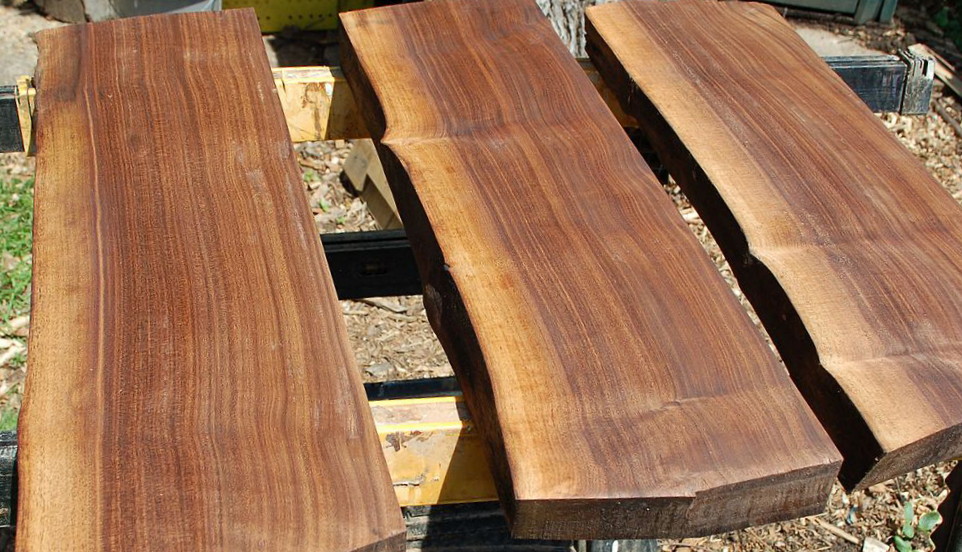
The first time you plane a walnut board and that chocolate-purple ribbon curls off the iron, you'll understand why woodworkers hoard this stuff. This is the wood America saves for its best occasions — it stocked every military rifle from Lexington to Vietnam, built two centuries of 'good' furniture, and a single veneer-grade walnut log can still out-bid a used pickup at auction. When someone asks why your table cost so much, hand them a walnut offcut and let them feel the answer.
Machines and glues beautifully; the classic American furniture wood. Straight grain with chocolate heartwood; sapwood is pale and often steamed.
Black Walnut at a glance
| Price per board foot | $9.50 (2026-08) |
| Weight, dry | 38 lb/ft³ · 3.2 lb per BF |
| Janka hardness | 1,010 lbf |
| Shrinkage, green → oven-dry | 7.8% tangential · 5.5% radial |
| Cost of 10 BF | $95.00 |
| Cost of 25 BF | $237.50 |
What common thicknesses cost
Same 6″ × 8′ board, priced by rough thickness (thicker stock often carries a small premium on top of this — figured on volume alone):
| Thickness | Board feet | Cost | Weight |
|---|---|---|---|
| 4/4 | 4.0 | $38.00 | 13 lb |
| 6/4 | 6.0 | $57.00 | 19 lb |
| 8/4 | 8.0 | $76.00 | 25 lb |
| 12/4 | 12.0 | $114.00 | 38 lb |
Will it stay flat?
Once walnut is properly dry, it mostly minds its manners — good news for your first big glue-up. Gunstock makers didn't choose it by accident — a rifle that shoots straight in August has to shoot straight in January, and walnut holds its shape better than most of its neighbors on the rack.
The measured numbers: drying from green, black walnut shrinks about 7.8% across a flatsawn board's width (tangential) and 5.5% across quartersawn (radial) — that ratio is why the two cuts behave so differently in your house.
Buying black walnut without regrets
Most commercial walnut has been steamed, which bleeds the dark heart color into the pale sapwood and mutes the whole board toward gray-brown. If you've ever wondered why a friend's air-dried walnut glows purple and yours doesn't — that's why. Ask your yard which they carry. And don't fear 'character' grade; knotty walnut is fashionable right now and priced kindly.
At the finishing bench
Skip the stain aisle entirely. A coat of oil is the moment you built the whole project for — the grain goes three-dimensional in a way no photo captures. Fair warning for repairs down the road: walnut is the rare wood that lightens with age, drifting from purple toward honey, so a patch cut from fresh stock will darken past the original.
Sources & further reading
Prices vary with region, grade, width, and figure. Cheaper neighbor: African Mahogany ($8.95). A step up: Purpleheart ($9.75).